Gopuff Success Story : How Two College Students Built a $15 Billion Instant Delivery Company
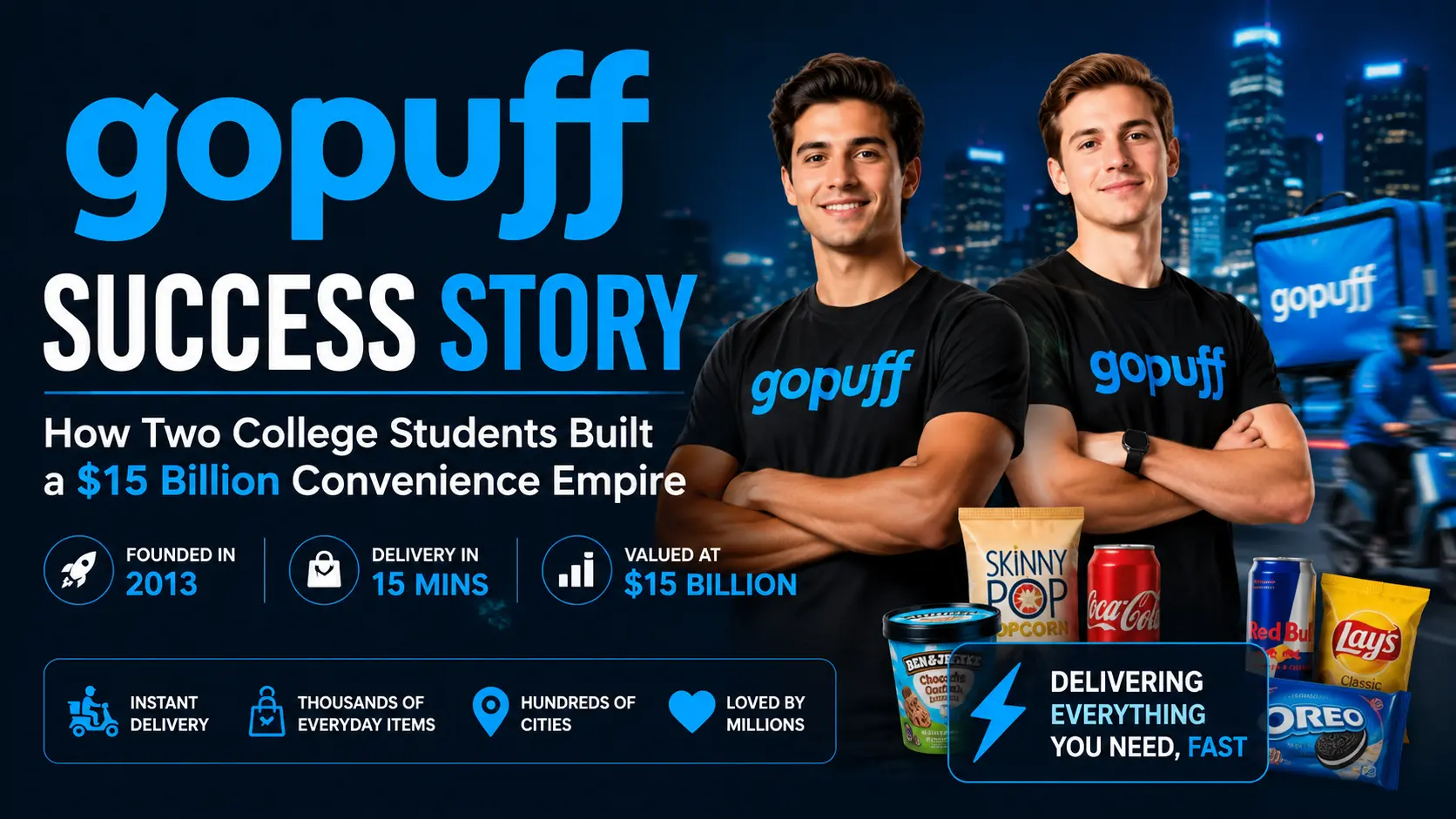
What started with a borrowed van and $750 became one of the world's biggest quick-commerce businesses.
Most successful companies don't begin with a revolutionary invention.
They begin with a simple observation.
For Gopuff founders Rafael Ilishayev and Yakir Gola, that observation happened in a college dorm room.
Students constantly needed snacks, drinks, phone chargers, and other essentials late at night.
The products were easy to find.
The inconvenience was getting them.
That small frustration eventually became a billion-dollar opportunity.
What is Gopuff ?
Gopuff is a quick-commerce and instant delivery company founded in 2013 in Philadelphia, USA.
The platform allows customers to order:
-
Snacks
-
Groceries
-
Beverages
-
Household Essentials
-
Health & Wellness Products
Unlike traditional delivery platforms, Gopuff operates its own network of micro-fulfillment centers, allowing deliveries in as little as 30 minutes.
At its peak, the company reached a valuation of approximately $15 billion.
How Did Gopuff Start ?
Before Gopuff, late-night shopping was surprisingly difficult.
Imagine needing:
-
Medicine
-
Snacks
-
A Phone Charger
at midnight.
Your options were limited.
Drive to a convenience store.
Wait for traditional grocery delivery.
Or simply go without.
The founders noticed this problem repeatedly among students.
Instead of asking :
"What startup should we build?"
They asked :
"Why is getting everyday essentials still so inconvenient ?"
That question became Gopuff.
Starting with only $750 and a borrowed van, the founders began delivering products directly to customers.
The Problem Gopuff Solved
Most people think Gopuff delivers products.
Not exactly.
Gopuff delivers convenience.
The company removed several frustrations :
-
❌ Long grocery delivery windows
-
❌ Store closing hours
-
❌ Minimum order requirements
-
❌ Unpredictable delivery times
❌ Unnecessary trips to convenience stores
By eliminating these friction points, Gopuff transformed convenience into a product customers were willing to pay for.
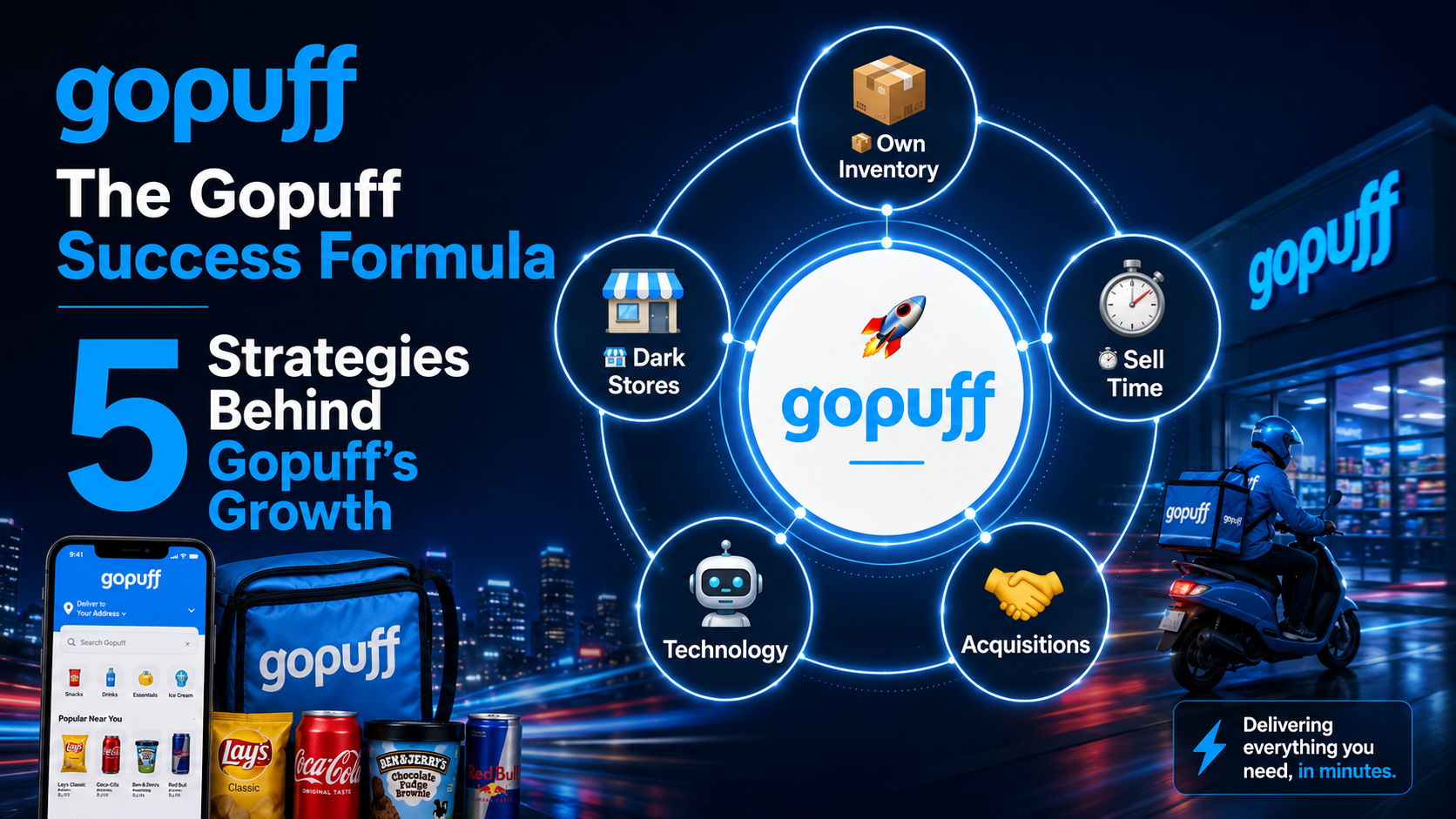
Key Strategies Behind Gopuff's Success
1. They Owned the Inventory Instead of Relying on Stores
Most delivery platforms act as middlemen. When a customer places an order, the platform sends that order to a local store, waits for the store to prepare it, and then assigns a driver for delivery.
This model is easy to launch but difficult to control.
-
If a store runs out of stock, the customer blames the delivery platform.
-
If the store takes too long to prepare an order, the customer blames the delivery platform.
-
If the product quality is poor, the customer still blames the delivery platform.
Gopuff realized that relying on third-party stores would limit its ability to provide a consistent customer experience.
Instead of becoming a marketplace, Gopuff became the retailer.
The company purchased inventory directly, stored products in its own facilities, and controlled what was available to customers.
This strategy gave Gopuff several advantages:
-
Better profit margins because there was no retailer taking a share
-
Faster fulfillment because products were already in stock
-
Better inventory visibility
-
Greater control over customer experience
-
Consistent service across multiple locations
While competitors focused on expanding partnerships, Gopuff focused on controlling the entire value chain.
The result was a business model that was harder to replicate and easier to optimize.
Key Lesson :
The more critical parts of the customer experience you control, the easier it becomes to deliver a reliable service.
2. They Built a Dark Store Network Before It Became Popular
One of Gopuff's smartest decisions was investing heavily in what are now known as micro-fulfillment centers or dark stores.
Unlike traditional retail stores, dark stores are not designed for walk-in customers.
They exist solely to fulfill online orders as quickly as possible.
At a time when most delivery companies relied on supermarkets and convenience stores, Gopuff built its own network of strategically located fulfillment centers close to customers.
This allowed the company to dramatically reduce delivery times.
Think about the difference :
A traditional delivery platform must :
-
Receive the order
-
Send it to a store
-
Wait for staff to locate products
-
Prepare the order
-
Assign a driver
Gopuff's process was much simpler :
-
Receive the order
-
Pick products from its own warehouse
-
Dispatch immediately
This operational advantage helped Gopuff promise deliveries in minutes rather than hours.
More importantly, it created a competitive moat.
Any company can build an app.
Building hundreds of fulfillment centers requires significant investment and operational expertise.
Key Lesson :
Technology can be copied. Infrastructure is much harder to copy.
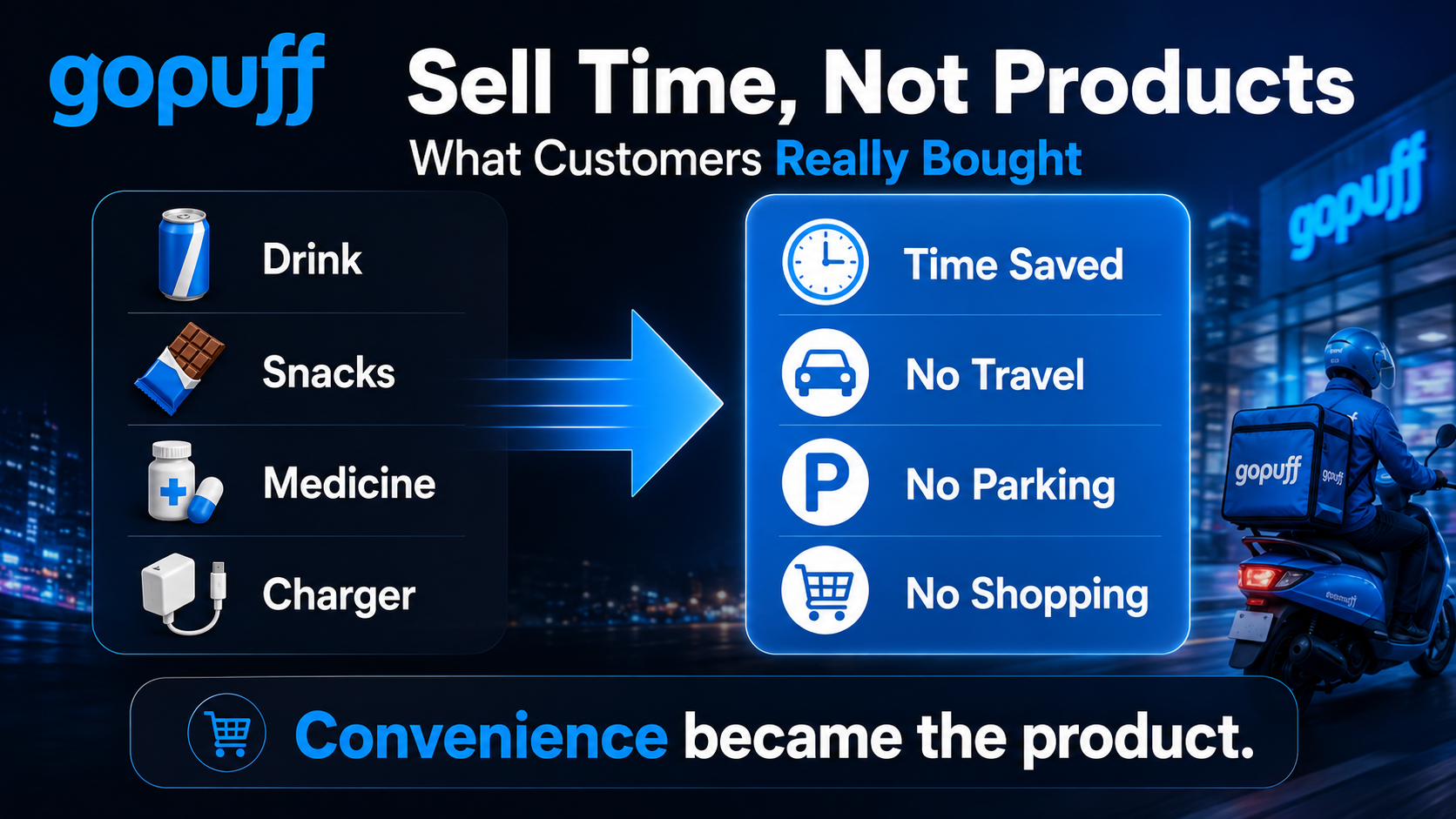
3. They Sold Time, Not Products
This may be the most important insight behind Gopuff's success.
Most businesses think they are selling products.
Great businesses understand what customers are actually buying.
When someone orders snacks from Gopuff, they are not paying extra because they love snacks.
They are paying to avoid :
-
Driving to a store
-
Finding Parking
-
Standing in Line
-
Wasting Time
The product is simply the vehicle.
The real value is convenience.
The founders recognized an important shift in consumer behavior.
As people's lives became busier, convenience became more valuable than small price differences.
Many customers would happily pay a few extra dollars if it saved them thirty minutes.
This understanding shaped every decision Gopuff made.
The company wasn't competing on price.
It was competing on convenience.
And convenience became one of the most valuable products in the digital economy.
Key Lesson :
Customers often buy outcomes, not products. Identify the outcome and build around it.
4. Technology Became Their Competitive Advantage
Many startups believe technology alone creates success.
Gopuff proved that technology is most powerful when it improves operations.
The company's technology investments focused on making the business faster, smarter, and more efficient.
1. Demand Forecasting
Gopuff used data to predict which products customers would likely order in each market.
For example, demand patterns for New York were different from demand patterns in Texas.
By understanding customer behavior, Gopuff could stock products more accurately and reduce inventory waste.
This improved both customer satisfaction and profitability.
2. Route Optimazation
Delivery speed was central to Gopuff's value proposition.
The company used route optimization algorithms to determine the fastest possible delivery paths.
this helped :
-
Reduce delivery times
-
Improve Driver Productivity
-
Lower Operational Costs
-
Increase customer Statisfaction
3. Warehouse Management
As order volumes increased, operational efficiency became critical.
Gopuff invested in warehouse systems that reduced picking and packing times.
Every second saved inside a fulfillment center translated into faster deliveries.
4. Customer Analytics
The company continuously analyzed customer behavior.
Questions such as :
-
Which products are most frequently purchased together?
-
Which customers are likely to reorder?
-
What time of day generates the highest demand?
These insights allowed Gopuff to improve retention and personalize the customer experience.
Technology was never the product.
Technology made the experience better.
Key Lesson :
Technology creates the most value when it improves operational efficiency, not when it simply adds features.
5. Strategic Acquisitions Accelerated Growth
Many startups try to build everything themselves.
Gopuff understood that sometimes buying growth is faster than creating it.
As the company expanded, it began acquiring businesses that could strengthen its ecosystem.
BevMo! Acquisition
One of Gopuff's most significant acquisitions was BevMo!.
This acquisition provided :
-
Existing retail locations
-
Distribution infrastructure
-
Warehousing capabilities
-
Supplier relationships
-
An established customer base
Instead of spending years building these assets, Gopuff acquired them instantly.
International Expansion Opportunities
Acquisitions also allowed Gopuff to accelerate expansion into new markets.
Rather than entering every region from scratch, the company leveraged existing businesses, infrastructure, and customer networks.
This reduced risk and accelerated growth.
The strategy was simple:
If building takes five years and buying takes six months, buying may be the smarter decision.
Strategic acquisitions allowed Gopuff to scale faster while strengthening its competitive position.
Key Lesson :
Growth doesn't always come from building. Sometimes it comes from acquiring capabilities that would take years to develop internally.
The Real Secret Behind Gopuff's Success
Looking back, Gopuff's success wasn't driven by one breakthrough idea.
It was the combination of multiple strategic decisions :
-
✓ Owning inventory
-
✓ Building infrastructure
-
✓ Selling convenience
-
✓ Using technology intelligently
-
✓ Scaling through acquisitions
Together, these decisions transformed Gopuff from a college startup into one of the world's most valuable quick-commerce companies.
The biggest lesson for entrepreneurs is simple :
Don't just build an app. Build a system that solves a customer problem better than anyone else.
Gopuff Business Model Explained
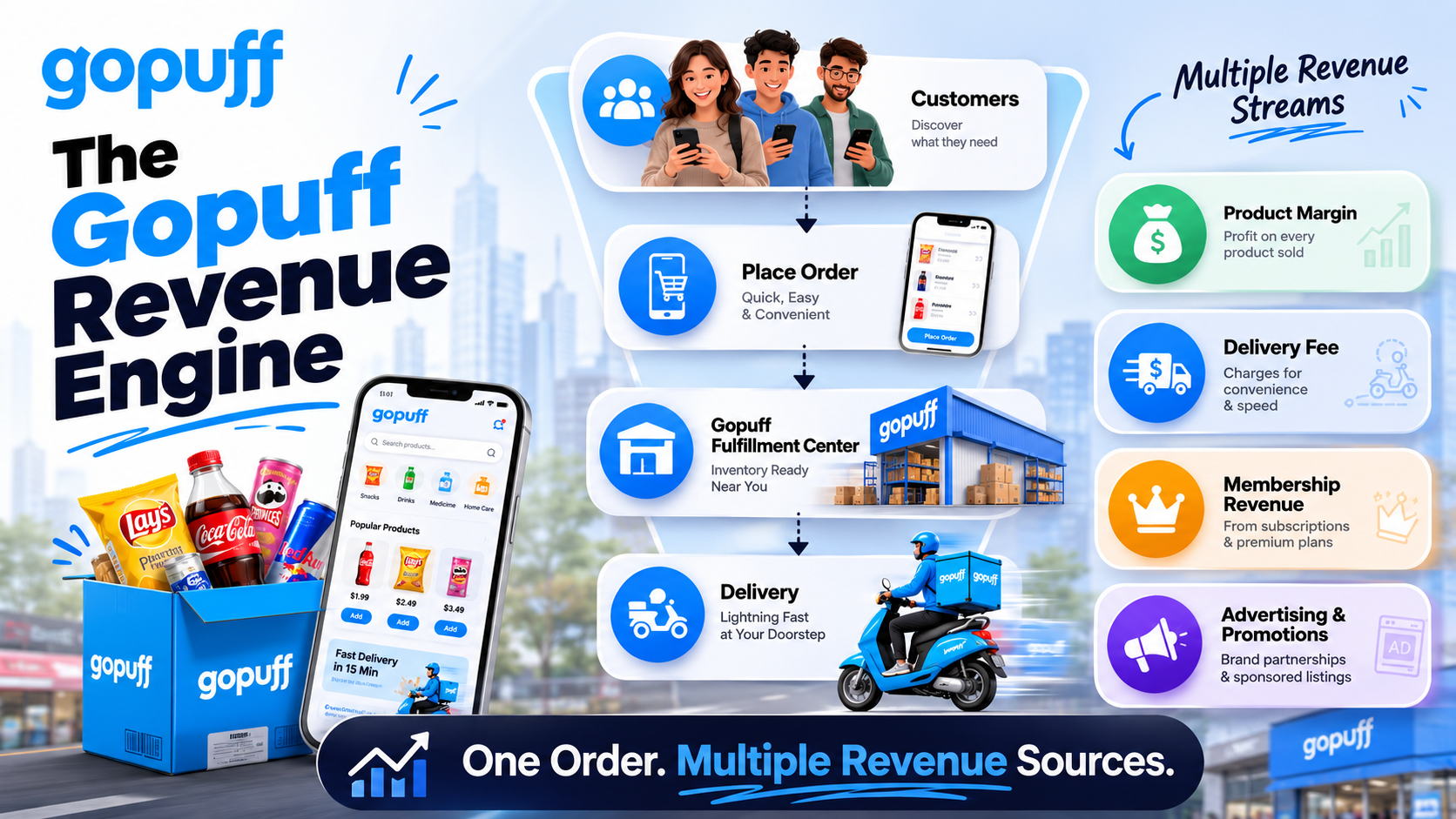
Gopuff generates revenue through multiple channels.
Product Sales
Margins from inventory sold directly to customers.
Delivery Fees
Convenience-based service charges.
Membership Programs
Recurring subscription revenue.
Private Label Products
Higher-margin in-house brands.
This diversified model helped improve long-term sustainability.
Why Did Gopuff Grow So Fast ?
Investors weren't investing in snacks.
They were investing in changing consumer behavior.
People increasingly wanted :
-
Instant Access
-
Fastest Delivery
-
Fewer Errands
-
More Convenience
Gopuff positioned itself at the center of this trend.
That vision helped attract billions in investment and achieve unicorn status.
What Entrepreneurs Can Learn From Gopuff
Solve a Small Problem First
Gopuff started with late-night essentials.
No Groceries.
Not everything.
Just one problem
Build Infrastructure Early
Owning critical parts of the operation creates long-term advantages.
Convenience Creates Loyalty
Customers remember businesses that save them time.
Technology Enables Scale
Operational excellence becomes a moat.
Follow Customer Behavior
The best opportunities often emerge from changing habits.
What This Means for Businesses Today
Gopuff's story proves something important.
Customers rarely care about your technology.
They care about the problem it solves.
Whether you're building :
-
A Delivery Platform
-
Grocery App
-
Marketplace
-
Logistic Startup
-
Super App
Success comes from removing friction from everyday life.
Want to Build an App Like Gopuff ?
Many entrepreneurs are looking to launch :
-
Quick Commerce Apps
-
Grocery Delivery Platforms
-
Instant Delivery Solutions
-
Dark Store Businesses
-
Last-Mile Delivery Platforms
However, Gopuff's success wasn't just about having an app.
It was about building an ecosystem.
How Ventagenie Helps Build Platforms Like Gopuff
At Ventagenie, we help businesses design and build scalable digital ecosystems.
Our expertise includes :
✅ Quick Commerce App Development
✅ Grocery Delivery Platforms
✅ Driver Applications
✅ Warehouse Management Systems
✅ Route Optimization
✅ Real-Time Tracking
✅ Analytics & Business Intelligence
✅ Scalable Cloud Infrastructure
We don't just build applications.
We help businesses build systems that solve real customer problems.
Final Thought
Gopuff didn't invent delivery.
It identified a growing demand for convenience before most people noticed it.
By removing small everyday frustrations and building an ecosystem around speed and reliability, two college students transformed a simple idea into one of the most valuable quick-commerce businesses in the world.
Great businesses don't start with apps. They start with problems worth solving.
Ready to build yours ?
🚀 Let's create your next growth ecosystem.
Frequently Asked Questions
Gopuff is a quick-commerce and instant delivery company that delivers groceries, snacks, beverages, household essentials, and everyday products directly from its own micro-fulfillment centers. Founded in 2013, Gopuff is known for fast delivery and a vertically integrated business model.
Gopuff was founded by Rafael Ilishayev and Yakir Gola while they were students at Drexel University in Philadelphia. What started as a small delivery service eventually grew into one of the world's largest quick-commerce companies.
Unlike traditional delivery platforms that rely on third-party stores, Gopuff owns inventory and stores products in its own fulfillment centers. When a customer places an order, products are picked, packed, and delivered directly from the nearest Gopuff facility, reducing delivery times significantly.
Gopuff generates revenue through multiple streams, including:
-
Product Sales
-
Delivery Fees
-
Subscription Memberships
-
Private Label products
-
Brand Partnership and Promotions
Its vertically integrated model allows greater control over margins and customer experience.
Gopuff succeeded because it focused on convenience rather than simply delivery. By controlling inventory, operating its own fulfillment centers, and optimizing logistics, the company created a faster and more reliable customer experience than many competitors.
DoorDash and Uber Eats primarily connect customers with restaurants and local stores. Gopuff operates its own inventory and fulfillment network, allowing it to control product availability, delivery speed, and customer experience more effectively.
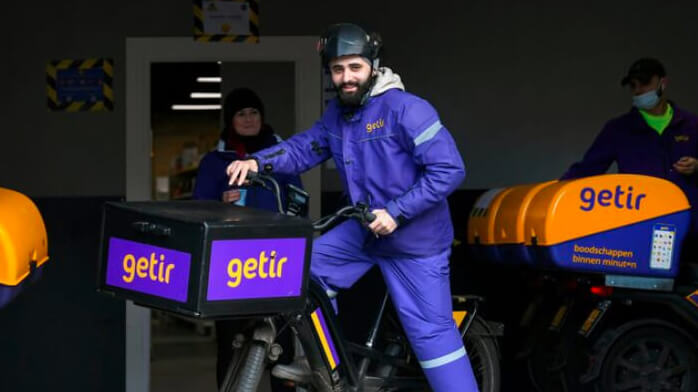
Quick commerce, often called q-commerce, refers to ultra-fast delivery services that provide groceries, essentials, and convenience products within minutes. Companies like Gopuff, Getir, and Gorillas helped popularize this business model.
Investors believed Gopuff was positioned to benefit from changing consumer behavior. As customers increasingly valued speed and convenience, the company expanded rapidly through infrastructure investments, technology, and strategic acquisitions, helping it achieve a valuation of approximately $15 billion.
The biggest lessons from Gopuff's success include :
-
Solve everyday customer frustrations
-
Build operational advantages, not just apps
-
Focus on convenience and customer experience
-
Invest in scalable infrastructure
-
Think beyond technology and build an ecosystem
The cost depends on features, platforms, logistics requirements, and integrations. A complete quick-commerce ecosystem typically includes :
- Customer App
- Driver App
- Admin Dashboard
- Inventory Management System
- Warehouse Management Software
- Route Optimization
- Real Time Tracking
- Payment Integration
The investment varies based on business requirements and scale.
Yes. Many startups and enterprises are building instant delivery platforms for groceries, medicines, food, and convenience products. Success depends not only on app development but also on logistics planning, inventory management, and customer experience design.
Ventagenie helps businesses build complete quick-commerce ecosystems, including :
- ✅ Customer Applications
- ✅ Delivery Partner Apps
- ✅ Warehouse Management Systems
- ✅ Real-Time Tracking
- ✅ Route Optimization
- ✅ Analytics & Reporting
- ✅ Scalable Cloud Infrastructure
- ✅ Business & Product Consulting
We don't just build apps. We help businesses build ecosystems that solve customer problems and support long-term growth.